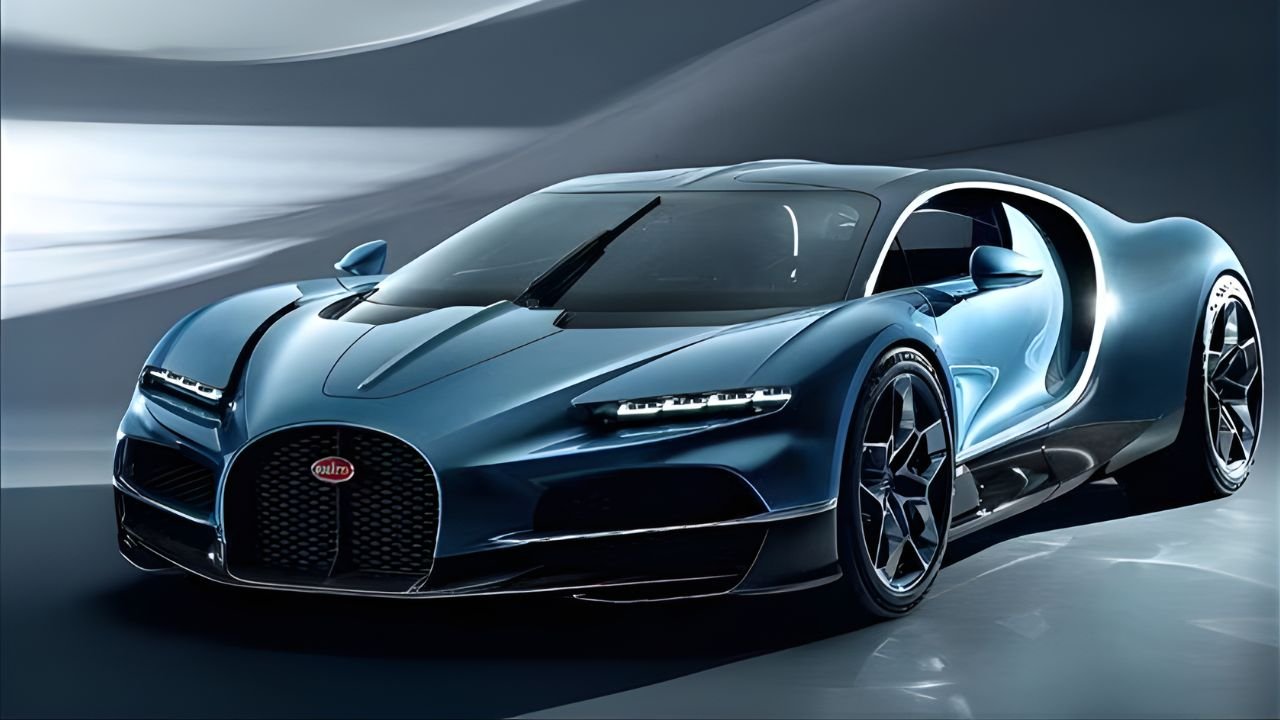
The 2026 Bugatti Tourbillon is an incredible example of analog engineering and is a stark contrast to the digital efficiency emerging in the car industry today. The Tourbillon is named after a mechanism in higher-end watches that balances gravity. The Tourbillon also reimagines what a hypercar is going to look like in the hybrid era. Bugatti is moving away from the famed quad-turbocharged W16 engine that defined the brand for 20 years. Bugatti is now using a new naturally aspirated V16 engine from Cosworth. This engine is designed to perform at 9,000 revolutions per minute and is going to build up a lot of noise for the driver. With this engine and a new electric system featuring three motors, Bugatti honors their past but also embraces the future.
V16 Hybrid Performance
The Tourbillon uses a naturally aspirated V16 engine that produces 1,000 horsepower by itself. The rest of the automotive industry is going smaller with more turbocharged engines, so Bugatti going much bigger and no turbos is a statement of mechanical purity. The V16 runs with an 800-volt hybrid system with two front axle electric motors and one rear electric motor. This solo adds an additional 800 horsepower and makes the total 1,800 horsepower. The electric motors also provide instantaneous torque and effectively eliminate any performance gaps. The car goes from 0 to 100 km/h in just 2.0 seconds. The mix of old-school displacement and new-age electrons keeps the Tourbillon as the undisputed king of the hypercar hierarchy.
| Feature | Specification Details |
| Engine | 8.3L Naturally Aspirated V16 |
| Total Horsepower | 1,800 HP (1,000 HP Gas / 800 HP Electric) |
| Top Speed | 445 km/h (277 mph) with Speed Key |
| Acceleration | 0–100 km/h in 2.0 Seconds |
| Transmission | 8-Speed Dual-Clutch (Longitudinal) |
| Electric Range | Approx. 60 km (37 miles) |
Dialing Up Luxury in the Interior
Entering the Tourbillon is like being transported into the workshop of a Swiss master watchmaker. Where most modern vehicles have huge touchscreen displays, Bugatti has completely gone in the opposite direction. The focal point of the interior is a magnificent instrument cluster made of over 600 separate pieces, including titanium, rubies, and sapphires. The dials are designed by a Swiss master watchmaker; the gauges are all fully mechanical, with physical pointers that move with the precision of a luxury watch. The craftsmanship on the steering wheel matches that of the gauges; it has a fixed center, and the wheel is designed to rotate while the gauges are unobscured. The aim of Bugatti is to make sure their craftsmanship endures for a decade. This is all made possible by the fact that they are using physical objects, instead of being driven by fast-changing software. The center console has a small, high-definition screen that only the driver can see. It opens to show the reversing camera or Apple CarPlay only when the driver requests it.
Effective Weight Reduction and Aerodynamic Design
The Bugatti Tourbillon is even lighter than the Chiron, even though it has a 24.8 kWh battery pack and three motors. This is because it has a lot of T800 carbon composite on the monocoque, and it has 3D-printed parts on the suspension. The bodywork is all formed to act on airflow, and the company promises that the principle of “Form Follows Function” is true here. The famous C-line is still there, but is now much more part of the car’s cooling and aerodynamic design. The back has a giant active wing that is an air brake and is closed during high speed runs to reduce drag, and the front of the car has an “eight-eye” LED headlight signature that is aimed down, which gives the front of the car an even more aggressive and lower look. All of this design work on the weight and airflow create a Tourbillon that has great stability and control at the top speed that it is limited to, which is 445 km/h.
The Future of the Molsheim Legacy
As the most exclusive model from the Molsheim production line, the Tourbillon has a production cap of 250 units. At 3.8 million euros, it is far more expensive than both the Veyron or the Chiron. In more ways than one, this price tag is not the most significant aspect of this model. Its most significant aspect is the start of the Bugatti-Rimac period, which, under teh control of Mate Rimac, is proving that electrification does not replace the soul of a combustion engine, but enhances it. The Tourbillon can drive silently and fully electric for city driving. However, once you hit a road with a speed limit higher than 9,000 rpm, that’s where the V16 is. This model Tourbillon sits between two worlds as it comes with the instant reponse and reliability of an EV and Bugatti’s emotional and everything else complex that has defined the legacy for more than a century.
FAQs
Q1 How much does the 2026 Bugatti Tourbillon cost?
Pricing for the Bugatti Tourbillon starts at roughly 3.8 million euros (around 4.1 million USD), but with the addition of bespoke customizations, most units will be priced higher.
Q2 Is the Bugatti Tourbillon fully electric?
The Bugatti Tourbillon is not fully electric; it is a plug-in hybrid. It has an 8.3-liter V16 engine and 3 electric motors, hence it has the ability to switch between combustion and electric driving.
Q3 What is the total number of Bugatti Tourbillons expected to be produced?
Bugatti has stated that there will only be 250 units produced, making it an instant collector’s item and ensuring its exclusivity.